
pi-cost user guide
A walkthrough of the dashboard and /cost commands. For theme authoring, see Theming.
Getting started
pi-cost ships as a pi extension and a standalone npm package. The fastest path is to install it into pi, then drive it with /cost slash commands.
Install
pi install npm:pi-costThis registers the /cost command inside pi. No further configuration is required — the dashboard reads pi's session logs from ~/.pi/agent/sessions/ directly.
Start the dashboard
From inside any pi session:
/cost startThe extension spawns the dashboard server in the background on port 5461 and reports back when it is ready.
Open the dashboard
/cost openOpens http://localhost:5461 in your default browser. The Overview view loads with aggregate spend across every project pi has touched.
That's it — the rest of this guide describes what you'll see and how to navigate it.
Without pi
If you don't use pi (or just want to peek at the UI), run the server directly:
npx pi-cost # http://localhost:5461The dashboard will be empty unless ~/.pi/agent/sessions/ contains session JSONL.
Slash commands
Run from inside pi (the extension registers /cost):
| Command | What it does |
|---|---|
/cost start | Start the local server (port 5461) in the background |
/cost stop | Stop the running server |
/cost restart | Restart the server (picks up theme/config changes) |
/cost status | Show whether the server is running |
/cost open | Open the dashboard in the default browser |
Layout
pi-cost has three views, navigated by hash route.
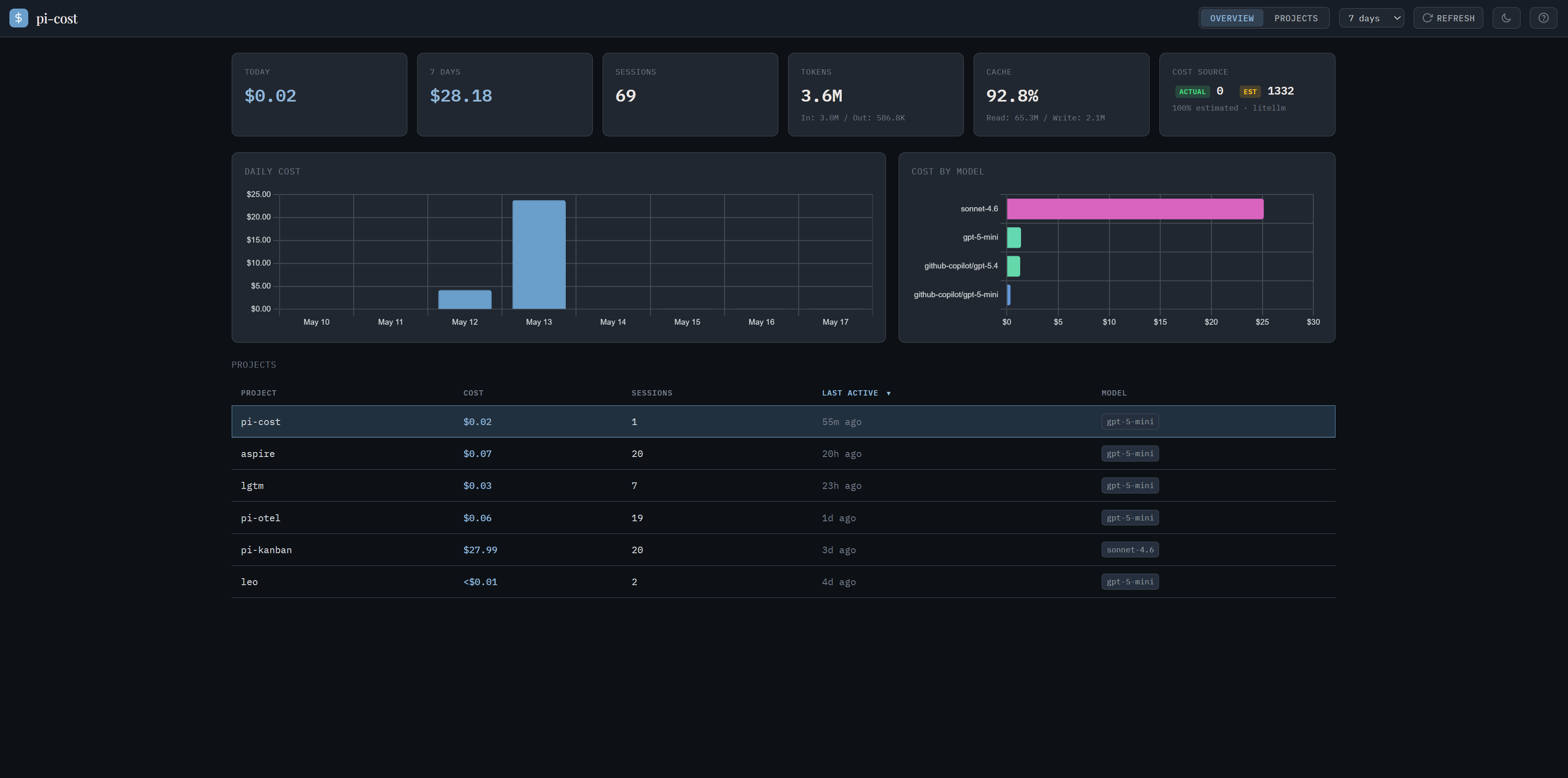
Overview — #/
Aggregate spend across all projects with daily and per-model breakdowns. The landing view.
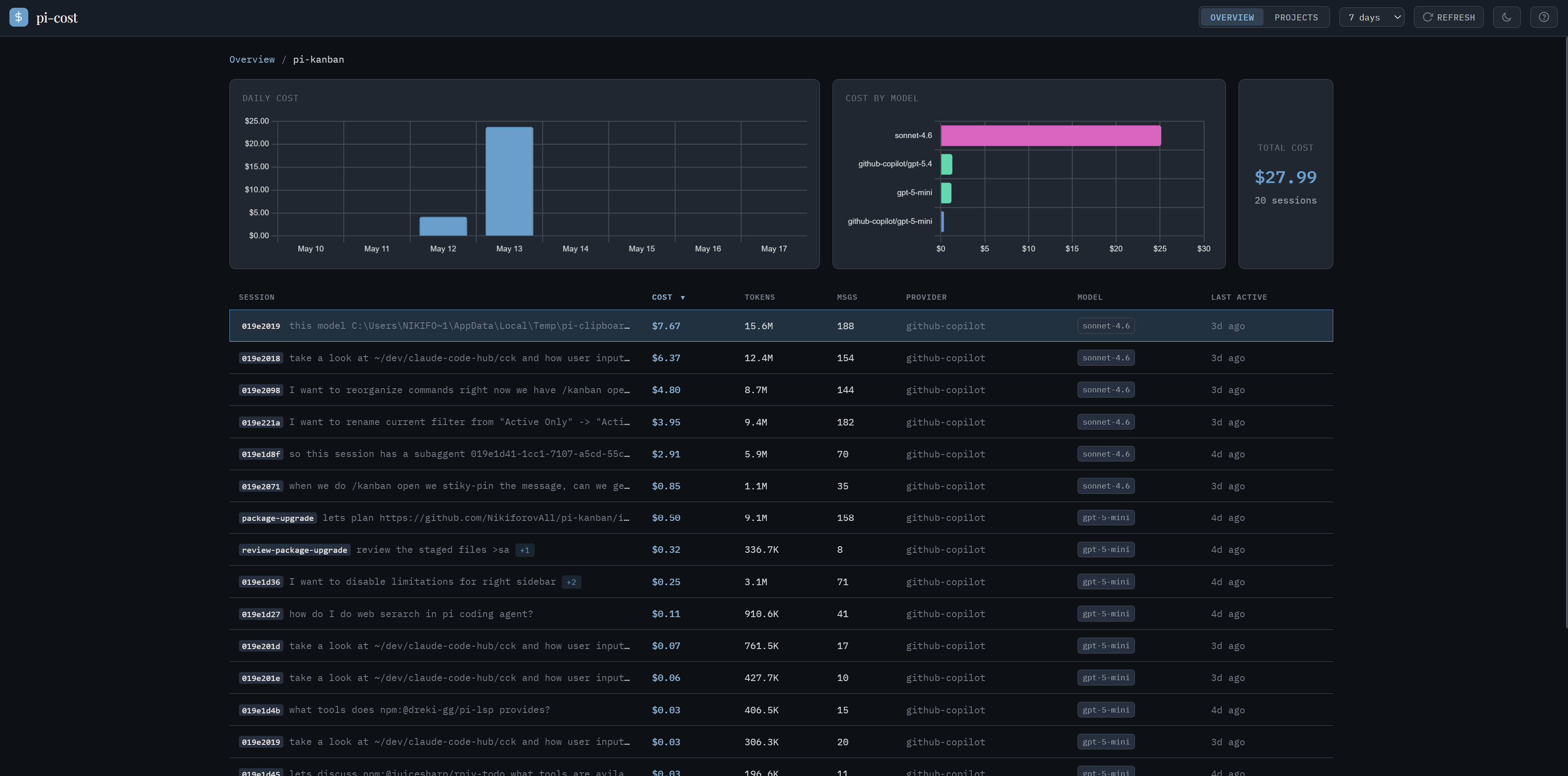
Project — #/projects/:encoded
Per-session list for one project, plus model totals for that project. :encoded is the URL-encoded project directory (pi encodes paths like --C--Users-foo-bar-- ↔ C:\Users\foo\bar).
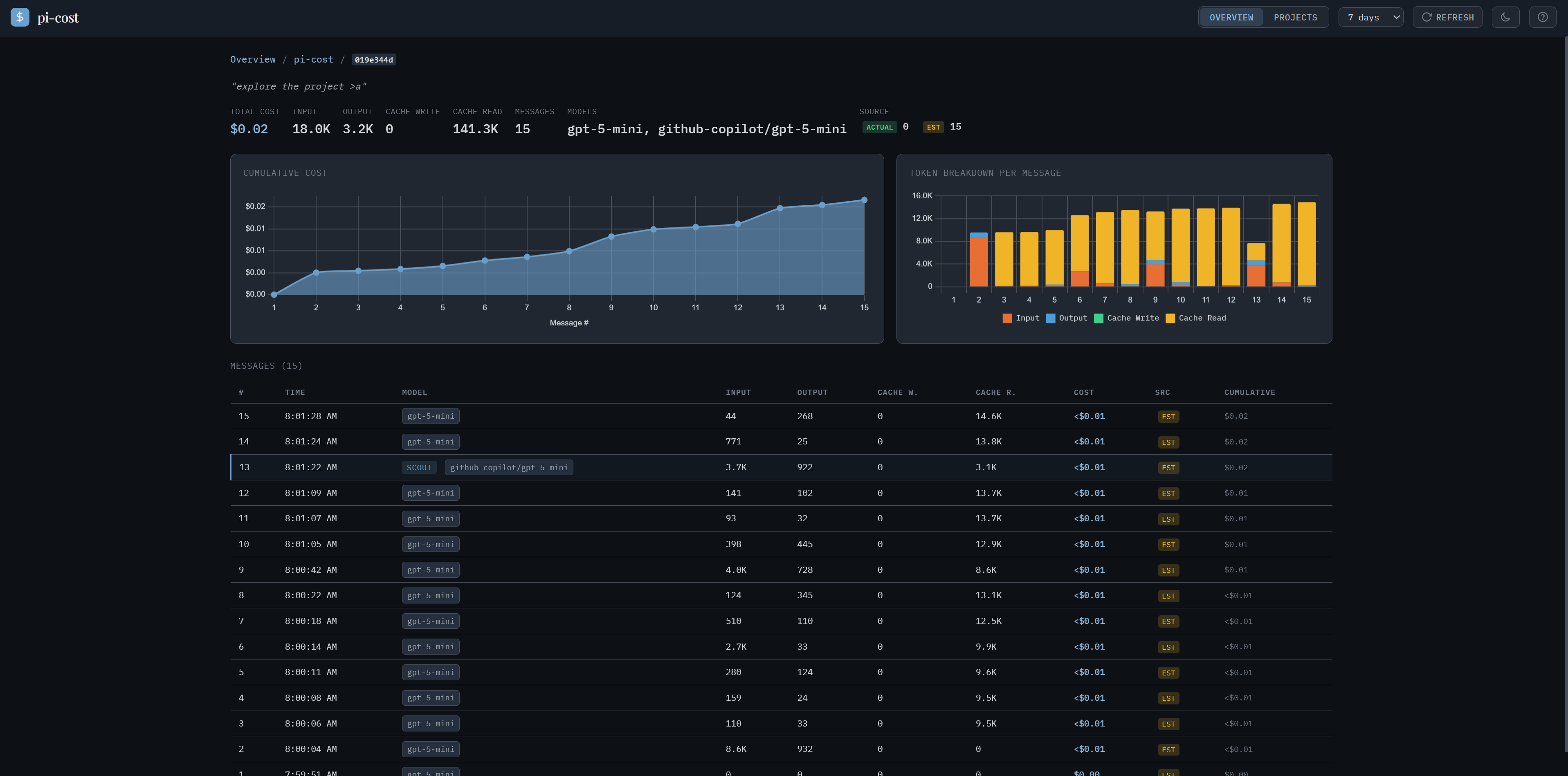
Session — #/sessions/:id
Per-message detail: model, tokens (input / output / cache read / cache write), and cost with a source badge.
Cost sources
Every message is tagged so you know where the number came from:
| Badge | costSource | Meaning |
|---|---|---|
| actual | jsonl | pi recorded a real price in the JSONL (dial, exa). |
| estimated | pricing | Computed from token counts × LiteLLM pricing (refreshed every 6 hours, offline fallback bundled). Used for subscription-billed providers like github-copilot and the auto router. |
| — | none | No usage data — typically a tool/system message. |
The per-message fallback chain:
usage.cost.total > 0→ actual- else
pi-pricinglookup against the LiteLLM table → estimated - else
0→ none
Session and project totals sum across all three, so subscription providers always get a nonzero estimate. Badges render inline in the session view above — look for jsonl / pricing chips next to each row's cost.
Themes
Press t (or the topbar toggle) to flip between the configured light and dark themes. Same session, two looks:
| Dark | Light |
|---|---|
| 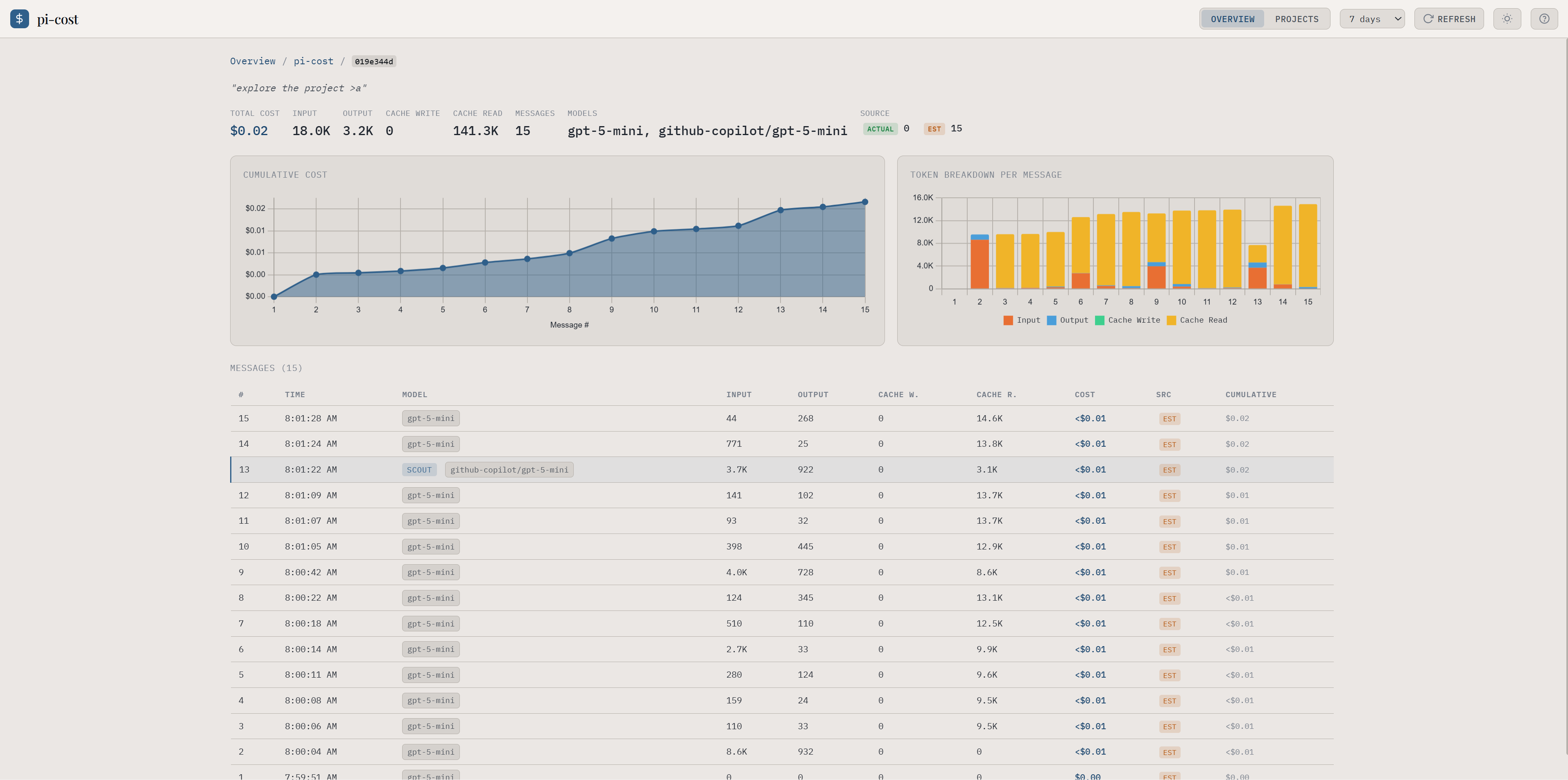 |
Four built-in themes ship out of the box (pi-light, pi-dark, classic-light, classic-dark); drop your own JSON in ~/.pi/agent/cost/themes/. See Theming.
Refreshing data
- The server caches
buildAll()in memory for 30 seconds. - Press
rin the dashboard, orPOST /api/refresh, to drop the cache and re-scan JSONL. - No file watcher / SSE — refresh is explicit.
Keyboard shortcuts
Press ? in the dashboard for the full list.
| Key | Action |
|---|---|
1 / 2 | Switch view |
j / k | Next / previous row |
Enter | Open selected row |
Esc / Backspace | Back / close modal |
r | Refresh data |
t | Toggle dark / light theme |
? | Show help |
Configuration
Settings live in ~/.pi/agent/cost/settings.json:
{
  "themes": { "light": "pi-light", "dark": "pi-dark" }
}
Environment variables (take precedence — useful for one-off runs):
| Variable | Effect |
|---|---|
COST_LIGHT_THEME | Theme ID used in light mode |
COST_DARK_THEME | Theme ID used in dark mode |
COST_THEME_DIR | Directory to load user themes from |
The server listens on port 5461 (sibling project pi-kanban uses 3460 — they don't collide).